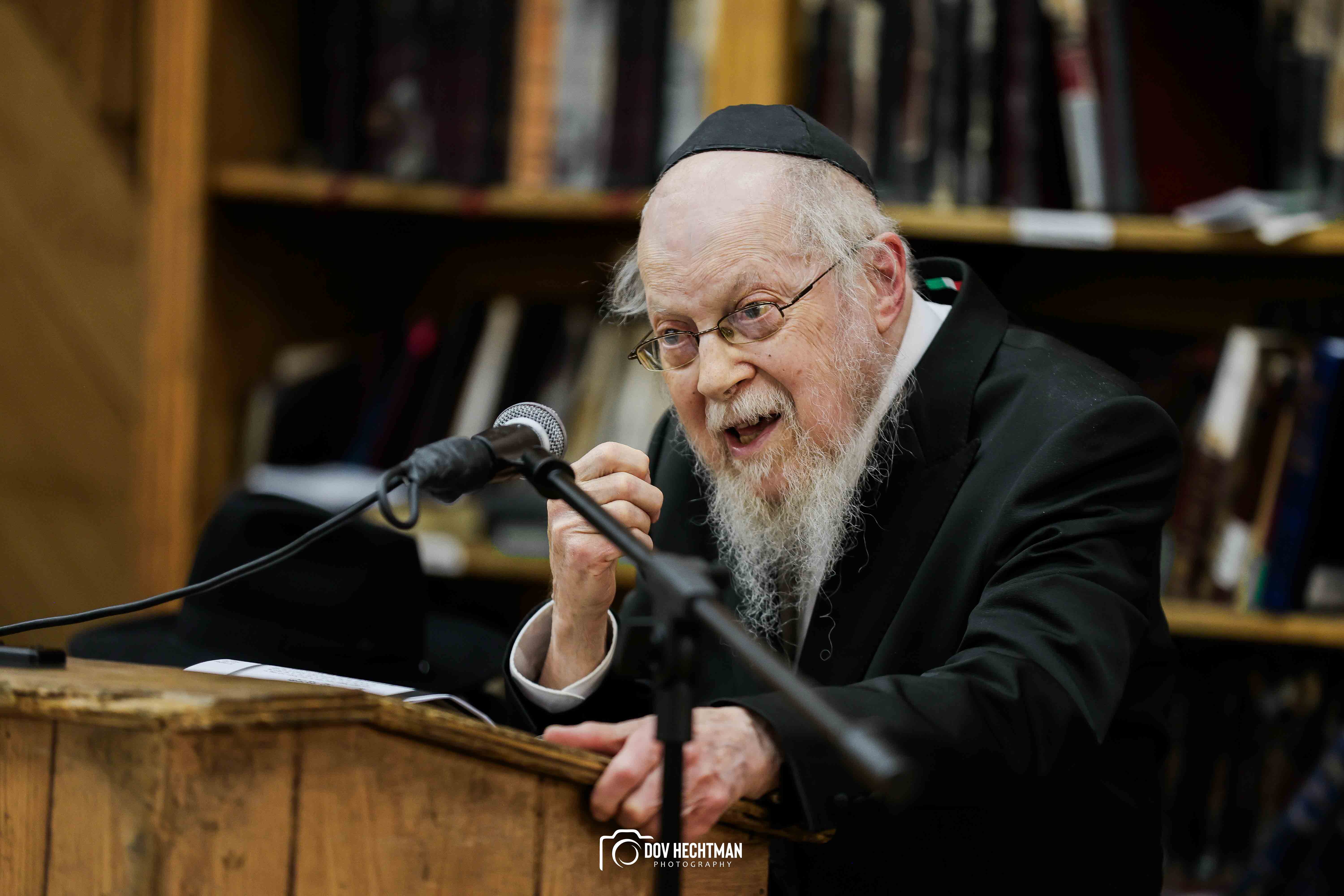
Mara d'asra and member of the Crown Heights Beis Din
Rabbi Avrohom Osdoba's Rulings on the Crown Heights Eruv
Rabbi Avrohom Osdoba has repeatedly addressed the Crown Heights eruv as a Rav of the neighborhood and a member of the Crown Heights Beis Din. His written statements span the first public dispute in 5776 and the later notices of 5782, 5783, and 5786. Across those documents, two points recur: the local Rabbonim must decide an eruv question from the actual conditions of the place, and the eruv publicized for Crown Heights does not permit carrying.
His clearest individual statement came in Iyar 5776, after an earlier letter of his had been presented publicly as leaving open the possibility of an eruv in Crown Heights.
The clarification of 8 Iyar 5776
On his own letterhead, Rabbi Osdoba addressed "all the residents of our neighborhood" and issued a clarification. He wrote that he had received a detailed letter from Rabbi Yehuda Leib Groner, who had served for decades as the Rebbe's secretary, conveying the Rebbe's words concerning an eruv in the neighborhood.
"I received a detailed letter from the learned Rabbi Yehuda Leib Groner ... In it, he conveyed the Rebbe's words: 'I will not permit an eruv to be made here in the neighborhood.' It is therefore plain and understood that nothing remains after the word of the king, and no one may assist or support, in any manner, the construction of an eruv in our neighborhood."
The postscript dealt directly with what had been said about Rabbi Osdoba's earlier letter of 4 Iyar:
"Since people are publicizing and interpreting my letter of 4 Iyar as some form of support for the idea of establishing an eruv in our neighborhood, I hereby clarify that it never entered my mind to agree to build an eruv in our neighborhood."
He then added a halachic point of his own. In his words, establishing such an eruv in Crown Heights was not halachically possible according to the approach of the Alter Rebbe, and also according to other poskim. He did not set out the technical analysis in that clarification.
The letter reports Rabbi Groner's account of the Rebbe and gives Rabbi Osdoba's own ruling. Rabbi Osdoba expressly rejects the interpretation that his earlier letter amounted to support for the proposed eruv.
The Sivan 5776 notice
Later that year, Rabbi Osdoba joined Rabbi Shlomo Yehuda Halevi Segal in a longer notice addressed to Anash, guests, and residents of Crown Heights. It begins with the practical status of the neighborhood:
"In this neighborhood, Crown Heights, 'here G-d commanded the blessing,' there is no halachically valid eruv anywhere within the boundaries of the neighborhood. It is therefore forbidden for every man and woman, and for the members of their households, to carry out or bring in and to carry from one domain to another. Carrying is forbidden on holy Shabbos and on Yom Kippur, in accordance with the law of our holy Torah."
The notice places that conclusion within the earlier local psak. It refers to Rabbi Zalman Shimon Dworkin as the senior Rav and mara d'asra of Crown Heights and says that he had already issued an explicit ruling in Kislev 5739, together with other poskim in the United States and Canada led by Rav Moshe Feinstein, against establishing such an eruv in New York.
Rabbi Osdoba and Rabbi Segal also addressed reports that recognized Rabbonim or eruv experts had participated in the new construction. They wrote that, after inquiry, the people whose names had been publicized had told them that they had not taken part. The notice then turned to local rabbinic authority, stating that a Rav from another city should not enter the jurisdiction and act against the psak of the Rabbonim and dayanim of the community.
Its conclusion is unusually forceful. Anyone participating in the project, they wrote, was acting against the halacha, against the Rebbe's position concerning an eruv in Crown Heights, and against the psak of the local Rabbonim. The notice bears Rabbi Osdoba's handwritten signature.
Erev Sukkos 5782: categorical rejection
Five years later, Rabbi Osdoba and Rabbi Yosef Yeshaya Braun issued a new notice on Crown Heights Beis Din letterhead. They described the position of the local Rabbonim as having already been publicized, including their own position, that of Rabbi Aharon Yaakov Schwei, and the earlier position of Rabbi Dworkin. Their summary was two words in Hebrew: "b'shlila muchletes," categorical rejection.
They again cited the principle that the Rabbonim who know the local conditions must decide what is decisive in that particular place. They added the ruling of the Shevet HaLevi that eruv questions should not be decided from a distance, because "the matter rests upon the Rabbonim who are on site."
The notice then states the practical psak:
"In practice: on Shabbos it is absolutely forbidden to carry in the streets of the neighborhood, and this 'eruv' is treated as nonexistent."
Both Rabbi Osdoba and Rabbi Braun are visibly represented by handwritten signatures on the 5782 sheet, with their printed names and the title "member of the Beis Din" beneath them.
The claimed exterior walls did not change the psak
On 20 Teves 5783, Rabbi Osdoba and Rabbi Braun addressed a new argument. Publicity had claimed that "walls" outside Crown Heights altered the halachic situation. Their answer was explicit:
"It is understood and plain that there is no change whatsoever in the categorical rejection stated above, even after the publicity concerning the installation of purported 'walls' outside our neighborhood."
They did not use that letter to provide a full technical discussion of the claimed walls. They stated that the publicized construction did not alter their ruling, and they repeated the practical conclusion that carrying in the neighborhood streets on Shabbos remained absolutely forbidden and that the publicized eruv was treated as nonexistent.
The 5783 document again carries handwritten signatures above the printed names of Rabbi Osdoba and Rabbi Braun.
The ruling of 4 Tishrei 5786
The Beis Din returned to the issue before Yom Kippur in 5786, addressing residents and the many visitors in Crown Heights. The central ruling was stated without qualification:
"Within the Crown Heights neighborhood and its vicinity, it is forbidden to carry in a public domain and to transfer from one domain to another in any manner on Shabbos Kodesh and Yom Kippur."
The notice says that publicizing a permissive ruling causes people to violate the sanctity of Shabbos and to disregard the explicit ruling of the local Rabbonim. Because misleading notices could confuse visitors, it also placed responsibility on business owners not to assist conduct contrary to the Beis Din's directive.
A postscript again connected the local ruling to the Rebbe's position and to the earlier ruling of leading New York and Brooklyn Rabbonim headed by Rav Moshe Feinstein.
The surviving Hebrew scan prints the names of both Rabbi Avrohom Osdoba and Rabbi Yosef Yeshaya Braun as members of the Beis Din. It visibly shows one handwritten autograph, above Rabbi Osdoba's printed name. No second handwritten autograph is visible above Rabbi Braun's printed name in that scan. The document should therefore be described according to what is actually visible: both names are printed, while the visible autograph is Rabbi Osdoba's alone.
Taken together, Rabbi Osdoba's own clarification and the later rulings leave no ambiguity about his practical psak for Crown Heights. He rejected the proposed eruv in 5776, joined subsequent Beis Din rulings maintaining that position, and continued to prohibit carrying in the neighborhood streets on Shabbos and Yom Kippur.