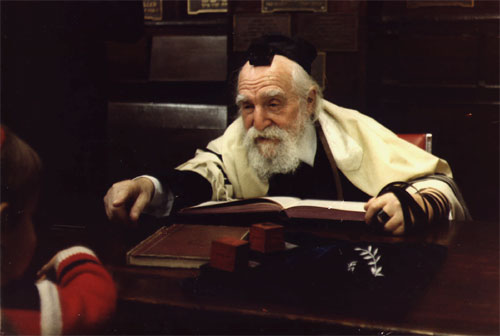
Leading posek and president of Agudath HaRabbonim
Rabbi Moshe Feinstein on Eruvin in Manhattan, Brooklyn, and Large Cities
Rabbi Moshe Feinstein addressed the halachos of city eruvin repeatedly over the course of several decades. His responsa discuss the physical boundaries of Manhattan and Brooklyn, the meaning of reshus harabim, the role of shishim ribo, bridges and elevated railways, the effect of visitors and commuters, and the practical responsibility of Rabbonim when an eruv is proposed in a large city.
His position cannot be reduced to a general opposition to eruvin. In Orach Chaim IV:86 he approved the eruv in Kew Gardens Hills, describing it as a great benefit where the neighborhood was small, the highway was excluded, the physical concerns were remote, and the eruv was supervised before each Shabbos. On the very next pages, however, he explained why he regarded New York's much larger settings differently. Concerning Manhattan, Brooklyn, Flatbush, and Boro Park, he repeatedly concluded that the relevant areas could not be treated like the smaller communities in which ordinary eruvin had long been accepted.
For Crown Heights, Rav Moshe's writings are important because Crown Heights is part of Brooklyn and because his analysis is one of the major halachic treatments of Brooklyn as a large urban area. His responsa do not replace the psak of the Crown Heights Rabbonim. They establish the broader Brooklyn and large-city framework within which the local question must be understood.
The first responsa on Brooklyn and Manhattan
Rav Moshe's first extensive treatment appears in Igros Moshe, Orach Chaim I:138–139. Siman 138, dated Erev Shavuos 5712, opens by recalling a discussion after Chol Hamoed Pesach about proposed eruv arrangements in Brooklyn and Manhattan. It then examines whether particular structures could function as halachic walls, including the elevated railway and the possibility of relying on pi tikra yored vesosem. Rav Moshe did not accept the elevated structure as a simple solution for enclosing the public domain. (Igros Moshe, O.C. I:138, HebrewBooks PDF pp. 229–232.)
Siman 139 turns directly to Manhattan. Rav Moshe considered the island's unusual physical features seriously. Its waterfront and embankments could, in some places and according to some opinions, provide substantial boundaries. He therefore did not begin with the assumption that Manhattan lacked every possible form of enclosure. The responsum instead works through the effect of breaches, bridges, tunnels, public passage, doors, and the different opinions concerning a reshus harabim.
That distinction matters. Rav Moshe's conclusion concerning Manhattan came after considering the arguments for treating its natural and built boundaries as halachically significant. His final position was that those arguments did not provide a basis on which he could permit the eruv.
Read Igros Moshe, Orach Chaim I:138 in full.
Read Igros Moshe, Orach Chaim I:139 in full.
Shishim ribo as a city-wide question
One of Rav Moshe's most consequential points in I:139 concerns the opinion that a reshus harabim requires shishim ribo, six hundred thousand people. He argued that this requirement should not be understood as demanding six hundred thousand people on each individual street. In his discussion of the language of Rashi, the Rosh, and the Shulchan Aruch, he writes:
“ולכל היותר שישנם ברחובות כל העיר ס׳ רבוא.”
“At most, the requirement is that six hundred thousand be present in the streets of the entire city.”
(Igros Moshe, O.C. I:139, anaf 5, HebrewBooks PDF p. 239.)
He likewise writes that a city whose permanent population is below six hundred thousand can still reach the relevant number when those entering it each day are included. In his words, “בצירוף עם הנכנסים בתוכה בכל יום” can be counted together with the city's inhabitants. (Igros Moshe, O.C. I:139, anaf 5, HebrewBooks PDF p. 239.)
Rav Moshe did not limit the count to adult Jewish men. At the end of the responsum he discusses non-Jews, women, and children and concludes that the public character of the streets is not divided among those categories. (Igros Moshe, O.C. I:139, HebrewBooks PDF p. 241.)
This is the conceptual basis for the population analysis he later applied to Brooklyn. The full range of opinions concerning shishim ribo belongs in the discussion of what six hundred thousand means. Rav Moshe's own application is important here because it explains why he did not ask whether six hundred thousand people passed a particular Crown Heights, Flatbush, or Boro Park street.
Manhattan and the distinction between disagreement and permission
Rav Moshe returned to Manhattan in Orach Chaim IV:89, dated 3 Chanukah 5721 and addressed to Rabbi Eliyohu Jung. He referred explicitly to his earlier analysis in I:139 and stated that he saw no reason to change his conclusion:
“והמסקנא לע״ד דמאנהעטאן ל״ד למה שנהגו להקל בשאר מקומות.”
“My conclusion is that Manhattan is not comparable to the other places where the custom was to be lenient.”
(Igros Moshe, O.C. IV:89, HebrewBooks PDF p. 174.)
The same responsum contains an important qualification. Rav Moshe wrote that he did not believe he could protest against qualified Rabbonim who, after reaching their own halachic conclusion, established an eruv. He described them as “רבנים גדולים” who were fit to rule. That statement concerned whether he could stop other Rabbonim from acting according to their own psak. It did not change his own ruling. He immediately added, “אבל אני בעצמי איני יכול לסייע בזה,” “I myself cannot assist in this.” (Igros Moshe, O.C. IV:89, HebrewBooks PDF p. 174.)
The later record removes any possible ambiguity about whether this reluctance to protest could be used as Rav Moshe's own permission.
Read Igros Moshe, Orach Chaim IV:89 in full.
On 18 Sivan 5722, the Union of Orthodox Rabbis issued a ruling against establishing the Manhattan eruv. The surviving facsimile carries Rav Moshe's visible autograph together with those of other leading Rabbonim. The notice states that the organization had decided to publicize its ruling that no eruv should be established in Manhattan and that anyone relying on such an eruv would be considered a desecrator of Shabbos. The surviving image is a later faxed copy, but the signatures are visible on the reproduced ruling.
Read the Agudath HaRabbonim ruling of 18 Sivan 5722 in full.
Two years later, Rabbi Norman Lamm received a Western Union telegram from Rav Moshe dated March 18, 1964. Rav Moshe wrote in English that “in my opinion an eruv in Manhattan is osur” and concluded: “do not cite my name as one upon whom you rely for a heter in this matter.” He expressly referred both to his published responsum and to the Agudath HaRabbonim psak that he had signed.
Read Rav Moshe's 1964 telegram in full.
A further Union of Orthodox Rabbis notice appeared in HaPardes in 1966 (5726) under the heading “Concerning the Establishment of an Eruv in Manhattan.” It is dated 23 Nisan 5726 and reports an urgent executive meeting held on the first day of Chol Hamoed Pesach with Rav Moshe participating. The surviving printed page is badly blotched, so its legible heading, date, organizational attribution, and Rav Moshe's participation are firmer than a full reconstruction of every line of its text. It nevertheless forms part of the continuing public record of the Union's Manhattan position.
Read the 23 Nisan 5726 Union of Orthodox Rabbis notice in full.
Flatbush and the rumor that Rav Moshe had permitted
Orach Chaim IV:87 is especially important because Rav Moshe explains why he put his position in writing again. The responsum, dated 15 Shevat 5738, is addressed to the Rabbinical Board of Flatbush, whose chairman was Rabbi Israel Poleyeff. Rav Moshe recalls that when Rabbonim had come to discuss an eruv in Flatbush, he had initially said that he did not wish to involve himself because there were several halachic opinions and the relevant sefarim were available to the Rabbonim deciding the matter.
That response was subsequently repeated as though Rav Moshe himself had permitted the Flatbush eruv. He therefore wrote:
“מאחר שיצא קול שאני הוא מתיר ... הוכרחתי לכתוב מכתבי זה.”
“Since word went out that I am the one permitting it ... I was compelled to write this letter.”
He adds that the reported permission was contrary both to what he had written and to what he held lehalacha. (Igros Moshe, O.C. IV:87, HebrewBooks PDF pp. 171–172.)
The responsum then restates his understanding of shishim ribo. For a dense city such as New York or Brooklyn, he writes, it is entirely possible for six hundred thousand people to be present in the streets of a twelve-by-twelve-mile area even though no single street carries that number. He was not prepared to treat Flatbush as an isolated small town merely because the proposed eruv covered only one neighborhood.
Read Igros Moshe, Orach Chaim IV:87 in full.
Brooklyn's population, commuters, and public streets
Rav Moshe made the Brooklyn application still more explicit in Orach Chaim IV:88, dated 4 Shevat 5739. He opens by referring to the reason he had already explained orally for holding that “אין לעשות תיקון עירובין בברוקלין אפילו בחלק אחד כהא דפלעטבוש,” that an eruv should not be established in Brooklyn even in one part such as Flatbush. (Igros Moshe, O.C. IV:88, HebrewBooks PDF p. 172.)
He first treats the burden of establishing the actual population and street use within the relevant urban area. Brooklyn's dense apartment buildings, he notes, make comparison with the spread-out encampment in the Midbar especially difficult. He also discusses the large summer crowds at Coney Island and Brighton Beach as part of the factual question of how many people could be present in the area.
He then records information that, in his view, resolved the practical doubt. Rav Moshe writes that they had now seen a city map showing Brooklyn as approximately twelve miles by twelve miles and a little more. He continues:
“ודרים שם בקביעות קרוב לשלשה מיליאן ועוברים ושבים ממקומות אחרים ... קרוב למליאן.”
“Close to three million live there permanently, and close to a million come and go from other places.”
(Igros Moshe, O.C. IV:88, HebrewBooks PDF p. 173.)
He describes those coming from elsewhere as arriving for business, employment, and visits with relatives. These are Rav Moshe's contemporary figures and geographic description, not present-day census statistics. Their significance is the method he applied: permanent residents were not the only people relevant to the public use of the city.
Rav Moshe then explicitly declines to combine Manhattan with Brooklyn because the river separates them for this calculation. He writes that Brooklyn itself had far more than six hundred thousand in the relevant streets and concludes:
“וא״כ הוא רה״ר דאורייתא דודאי אין לתקן עירובין מדינא.”
“It is therefore a reshus harabim de'oraisa, in which an eruv certainly cannot be established as a matter of law.”
(Igros Moshe, O.C. IV:88, HebrewBooks PDF p. 174.)
The detailed historical and present-day statistics belong on the Brooklyn population and shishim ribo pages. What matters for Rav Moshe's position is that his Brooklyn ruling rested on a borough-wide urban calculation, not on a count taken at one intersection.
Read Igros Moshe, Orach Chaim IV:88 in full.
Boro Park and the letter of 17 Teves 5739
A separate letter on Union of Orthodox Rabbis letterhead, dated by hand 17 Teves 5739, states Rav Moshe's Brooklyn position in unusually direct terms. The letter identifies him on the stationery as president of the organization and bears his handwritten signature.
Rav Moshe writes that he joins the position of the leading Rabbonim of the Union of Orthodox Rabbis and other Rabbonim that an eruv may not be established in Brooklyn because, in his view, it is a reshus harabim de'oraisa. He then rejects reports that one could rely on the eruv made in Boro Park. His concluding warning is underlined in the facsimile:
“ולכן אני מזהיר שלא לעשות תיקון עירובין בשום שכונה בברוקלין ואסור לסמוך על העירוב שנעשה בבארא־פארק.”
“I therefore warn that no eruv be established in any neighborhood in Brooklyn, and it is forbidden to rely on the eruv made in Boro Park.”
The best presently available copy is not the Union's archival original. It is a later facsimile reproduced in the 2006 Cohen-Krasnjanski teshura, on printed page 39. The handwritten date and Rav Moshe's signature are visible in that reproduction. One textual discrepancy should remain visible rather than being silently corrected: the letter refers to an earlier responsum dated 4 Shevat 5738, while the canonical printed Orach Chaim IV:88 is dated 4 Shevat 5739.
Read Rav Moshe's letter of 17 Teves 5739 in full.
The public proclamations of 5739
Rav Moshe's individual responsa and signed Brooklyn letter were accompanied by broader public rulings from leading Rabbonim.
A Union of Orthodox Rabbis proclamation on 256 East Broadway letterhead, dated Kislev 5739, recalls the Union's Manhattan ruling of 18 Sivan 5722 and the Rabbonim who had participated in it, including Rav Moshe. It then states a broader principle in unusually clear language:
“וכמובן שאיסור הנ״ל כולל כל עיר גדולה ואין חילוק בין מאנהעטען לעיר אחרת.”
“The foregoing prohibition includes every large city; there is no distinction between Manhattan and another city.”
The surviving copy is a later highlighted reproduction. The sixteen names printed beneath the text are typeset names, not a surviving sheet of sixteen visible autograph signatures. Rav Moshe's own position does not depend on treating those printed names as signatures, because his responsa, the 1962 autograph ruling, the 1964 telegram, and the signed 17 Teves letter are independent first-person evidence of his view.
Read the Kislev 5739 Union of Orthodox Rabbis proclamation in full.
A separate Hebrew proclamation dated Kislev 5739, headed “A Severe Warning Against Establishing Eruvin in New York,” likewise invokes Rav Moshe's ruling and states that an eruv should not be established in any New York or Brooklyn neighborhood. A later English newspaper notice concerning the Flatbush eruv reproduces an English rendering of Rav Moshe's position and prints seventy-three rabbinic names, with “Moshe Feinstein” appearing first in the list.
The surviving English image is a close crop of the notice itself. It contains no masthead, issue date, volume number, page number, or neighboring newspaper material. Its exact original Jewish Press issue and page have therefore not been established. It should be described simply as a surviving reproduction of the seventy-three-name notice, without assigning it an unverified newspaper date. The names in that notice are printed names, not autograph signatures.
Read the Hebrew proclamation in full.
Read the seventy-three-name Flatbush notice in full.
Orach Chaim V:28: Rav Moshe's later restatement
Rav Moshe returned to the subject at great length in Orach Chaim V:28, dated 2 Adar I 5741 and addressed to Rabbi Mordechai Tendler and Rabbi Moshe Wasserman. The opening leaves no doubt about the subject he intended to clarify:
“אין לעשות עירוב בברוקלין אף בחלק אחד כפלעטבוש, וכן א״א לעשות בבארא פארק.”
“No eruv should be made in Brooklyn, even in one part such as Flatbush, and likewise it cannot be made in Boro Park.”
(Igros Moshe, O.C. V:28, anaf 1, HebrewBooks PDF p. 137.)
The responsum answers a long series of arguments for permitting large-city eruvin. Among them is the suggestion that people traveling in automobiles should not count toward shishim ribo because each vehicle is itself a separate reshus hayachid. Rav Moshe rejects that distinction. Modern automobile travel, he explains, is the ordinary form of public movement, and the people traveling by car are therefore included when evaluating public passage. (Igros Moshe, O.C. V:28, anaf 2, HebrewBooks PDF pp. 137–138.)
He also rejects the idea that parked automobiles along a street create halachic walls that eliminate the street's status, and he does not accept ordinary traffic regulations, tolls, or red lights as removing a road from the category of public use. (Igros Moshe, O.C. V:28, anafim 8–12, HebrewBooks PDF pp. 141–143.)
Boro Park receives direct attention later in the responsum. One argument proposed that the elevated railway and the covered street beneath it divided the public domain so that the people on opposite sides should no longer combine for shishim ribo. Rav Moshe rejects that calculation. A covered segment may have its own technical status for the melacha of carrying, he writes, but it does not thereby divide the human traffic into unrelated populations. He closes that discussion by returning to the point that he had already explained why no eruv should be made in Brooklyn, even in one part. (Igros Moshe, O.C. V:28, anaf 20, HebrewBooks PDF pp. 145–146.)
The responsum also addresses the practical attraction of an eruv. Rav Moshe acknowledges the real benefit of enabling families to go out with young children and of relieving the difficulty of carrying a key. He then sets against that benefit his concern that if large cities routinely depended on eruvin whose physical structures were scarcely noticed, knowledge of the melacha of hotza'ah itself could be weakened. (Igros Moshe, O.C. V:28, anaf 21, HebrewBooks PDF p. 146.)
His tone in this later responsum is therefore not that eruvin serve no purpose. The dispute is whether the proposed enclosure can work in the halachic and physical reality of the city in question. Concerning Brooklyn, Flatbush, and Boro Park, his conclusion remained negative.
Read Igros Moshe, Orach Chaim V:28 in full.
The visitor concern and Rav Moshe's later qualification
In I:139, Rav Moshe considers why Yerushalayim was not made permissible through an eruv according to an opinion that its doors and walls could otherwise allow one. He suggests that because people came to Yerushalayim from many places for the regalim, korbanos, and maaser sheini, Chazal may have wanted visitors to remain accustomed to the prohibition of carrying. A visitor who saw carrying in Yerushalayim might otherwise return to a place whose boundaries were not comparable and carry there as well. (Igros Moshe, O.C. I:139, anaf 5, HebrewBooks PDF pp. 240–241.)
Rav Moshe then applied that concern to Manhattan as a city receiving people from many places, with nearby places that could not necessarily be enclosed in the same way. He wrote that on this reasoning one should not establish an eruv in Manhattan even if its physical boundaries could otherwise be repaired. (Igros Moshe, O.C. I:139, HebrewBooks PDF p. 241.)
Almost three decades later, V:28 revisits the point and narrows its application. Rav Moshe expressly says that the Yerushalayim reasoning does not apply to ordinary towns merely because some visitors arrive from nearby places. He distinguishes New York in his own time because “המציאות הוא עתה שבאין לנוא יארק מכולי עלמא,” “the reality now is that people come to New York from all over the world.” He adds that modern air travel had made even distant places reachable within hours. (Igros Moshe, O.C. V:28, anaf 14, HebrewBooks PDF p. 143.)
He then states the qualification even more sharply: the concern is not a general rule for every large city. The text continues that New York is comparable to Yerushalayim for this purpose when there is otherwise no defect in the walls, and he adds that perhaps Brooklyn should be included on the same basis if its enclosure had no independent defect. (Igros Moshe, O.C. V:28, anafim 14–15, HebrewBooks PDF pp. 143–144.)
Thus the visitor argument is one strand of Rav Moshe's reasoning, not a universal principle that invalidates every city eruv. His Brooklyn ruling did not depend on that strand alone. His independent analysis of Brooklyn as a reshus harabim, its population, its commuters and visitors, and the inadequacy of the proposed enclosure remained in place.
Rav Moshe's position in the Crown Heights discussion
Across these responsa and public rulings, several points remain consistent.
Rav Moshe accepted the possibility and value of an eruv where the halachic and physical conditions supported it. His approval of Kew Gardens Hills is an explicit example. He also recognized in IV:89 that other qualified Rabbonim could reach a different conclusion about Manhattan and that he was not in a position to stop them from acting according to their psak.
At the same time, he repeatedly stated that his own ruling concerning Manhattan was not a heter, and in 1964 he expressly ordered that his name not be used as support for one. Concerning Brooklyn, he wrote that an eruv should not be established even in one section such as Flatbush; he applied the same conclusion to Boro Park; he classified Brooklyn as a reshus harabim de'oraisa on the facts before him; and in the signed 17 Teves 5739 letter he warned against establishing or relying on an eruv in any Brooklyn neighborhood.
That Brooklyn analysis belongs alongside, rather than in place of, the local Crown Heights record. The Brooklyn pages examine the borough's physical and population questions in full, while the Crown Heights Beis Din page gives the practical local psak. Rav Moshe's responsa explain why Brooklyn itself has occupied such a serious place in the halachic discussion of reshus harabim and large-city eruvin.