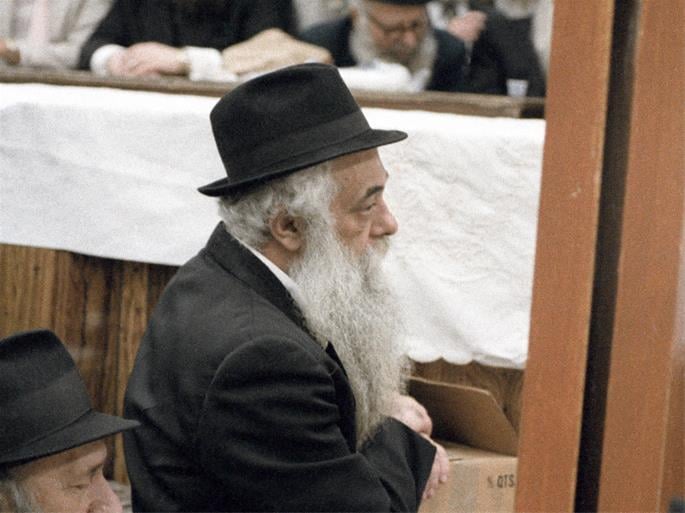
Chozer and principal editor of the Rebbe's Torah
Rabbi Yoel Kahn on the Rebbe's Position Concerning Eruvin in Large Cities
Rabbi Yoel Kahn, the Rebbe's principal chozer and a leading editor of his Torah, addressed two questions concerning a city eruv during the Three Weeks of 5776. His answer is a short Hebrew letter with a handwritten mark at the foot. The addressee was left incomplete in the surviving copy.
Rabbi Kahn bases his answer on the Rebbe's published letters in Igros Kodesh. He writes that those letters state the Rebbe's opposition to making and using an eruv in large cities, and he rejects the suggestion that later circumstances had changed that direction.
Rabbi Kahn's letter
The Hebrew text reads:
בתמי׳ גדולה קראתי את שתי השאלות בנוגע העירוב, והרי פשוט, שאין שום מקום לשאלה.
בנוגע שאלה הא׳ - הרי ישנם כו״כ מכתבים (נדפסו באגרות קודש) בהם מפורש שדעת רבינו זצוקללה״ה נבג״מ זי״ע היא נגד עשיית והשתמשות בעירוב בעיירות גדולות.
ובנוגע שאלה הב׳ - אין שום סברא שנשתנה המצב.
ובאם נאמר ש״נשתנה המצב״ - הרי זה פריצת גדר רח״ל בנוגע כל ההוראות של כ״ק רבינו זי״ע (וכמובן בנוגע כל ההוראות בתורתינו הקדושה) שעל כל דבר יאמרו נשתנה המצב ואל תפתח פה כו׳ וד״ל.
A faithful English rendering is:
I read with great astonishment the two questions concerning the eruv. It is plain that there is no basis for a question.
Regarding the first question: there are many letters, printed in Igros Kodesh, in which it is explicit that the view of our Rebbe, of saintly and blessed memory, is opposed to making and using an eruv in large cities.
Regarding the second question: there is no rationale at all for saying that the circumstances have changed.
If it is said that “the circumstances have changed,” this is a breach of the fence, Heaven preserve us, with respect to all the directives of our Rebbe (and, of course, with respect to all the directives in our holy Torah), because concerning every matter people will say that “the circumstances have changed.” “Do not open [your] mouth,” etc.; sufficient for one who understands.
Rabbi Kahn's complete letter is reproduced on its own page.
The published letters he was referring to
The Rebbe's city-eruv correspondence deals with several related matters. In the 5724 letter to Rabbi Eliyohu Jung, the Rebbe writes that where an eruv is permissible according to din, it should be instituted. He then leaves the qualification of the particular city to Rabbonim who have investigated its details in accordance with Hilchos Eruvin, and warns against publicizing an eruv on which people will become accustomed to carry.
The response concerning Melbourne states the publicity concern with particular force. The Rebbe writes that once a respected person or organization constructs an eruv, the matter will become known; at some point the eruv will be invalid on a Shabbos; and announcements will not necessarily stop people who have become used to carrying. He concludes that an eruv should be made only secretly.
Other letters and responses discuss the need for a Rav expert in these halachos, the physical and local questions of a particular city, and the danger of announcing completion of an eruv. The Rebbe's Position on Eruvin and Carrying in Large Cities presents these sources in sequence.
“The circumstances have changed”
Rabbi Kahn's second answer concerns continuity. He rejects the proposal that the Rebbe's written direction belonged only to an earlier set of circumstances and could be set aside by saying that conditions had changed.
His wording does not supply a new engineering analysis of a particular route. It addresses how he understood the Rebbe's already published instructions and whether they remained operative. The local physical and halachic questions still belong to the Rabbonim responsible for the place.
Crown Heights
Rabbi Kahn's letter speaks about large cities and does not name Crown Heights in its surviving text. Its place in the Crown Heights discussion comes from the time and subject in which it was circulated, together with the Rebbe's own city-eruv correspondence and the direct Crown Heights account of Rabbi Yehuda Leib Groner.
The practical ruling for Crown Heights was issued by the neighborhood Rabbonim. Their signed rulings prohibit carrying, state that the advertised eruv is treated as nonexistent, and reject establishing a neighborhood eruv without the agreement of the local Beis Din. The Crown Heights rulings are presented in full with the words of each psak.