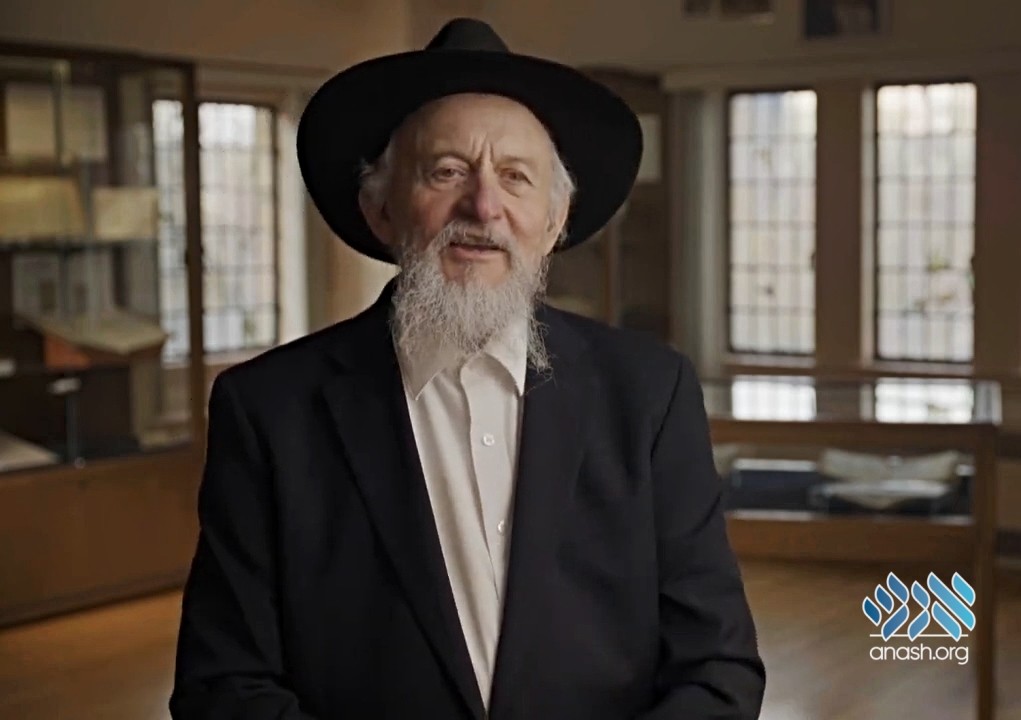
Scholar of Shulchan Aruch HaRav and director of the Chabad Library
Rabbi Sholom Dovber Levin on the Alter Rebbe, Reshus Harabim, and City Eruvin
Rabbi Sholom Dovber Levin devoted a substantial 2019 study to the laws of city eruvin according to the Alter Rebbe. The study reproduces the relevant sections of Shulchan Aruch Harav together with his Divrei Shalom notes and then applies those sources to the central questions raised by eruvin in large contemporary cities, including Brooklyn.
His work is halachic analysis rather than a Crown Heights Beis Din psak. Its particular value is that he states the principal grounds offered for permitting a large-city tzuras hapesach and answers each one from his reading of the Alter Rebbe and related poskim.
The four grounds Rabbi Levin examines
Rabbi Levin begins his practical discussion by setting out four reasons that some contemporary Rabbonim have used to permit a tzuras hapesach in large cities.
1. No single street has six hundred thousand daily passersby
The first approach says that a street is not a reshus harabim unless six hundred thousand people pass through that particular street every day. On that reading, most city streets would remain a karmelis and could be enclosed by tzuras hapesach.
Rabbi Levin argues that this cannot be the meaning of the Alter Rebbe's formulation. He reads shishim ribo as referring to a city with a population of six hundred thousand whose public roads are made for and serve that population, not to six hundred thousand people crossing one sixteen-by-sixteen-amah point within one day.
He illustrates the problem with a literal single-point count by calculating how many people would have to pass each second through such a small area. He also uses Eastern Parkway as a Brooklyn example, describing its width, length, intersecting streets, and aggregate use by pedestrians, cars, and the subway. Those particular measurements and traffic totals are Rabbi Levin's own factual examples in the pamphlet; the study does not cite census, MTA, traffic, or GIS data for them. They should therefore be read as part of his application, not as independently established statistics.
The larger dispute over what shishim ribo means, and how New York figures enter the calculation, is treated separately on Shishim Ribo and the Requirement of Six Hundred Thousand and Shishim Ribo in New York City and Brooklyn.
2. The streets are not straight from gate to gate
The second ground says that a reshus harabim must run straight through a city from one gate to the opposite gate. Modern streets often curve, turn, end, or meet other streets, so the argument concludes that they do not qualify.
Rabbi Levin reads the gate-to-gate condition differently. He argues that the requirement of aligned gates is stated for a city surrounded by a wall. Where a city has no surrounding wall, he says, its public roads do not lose their status merely because the streets are not aligned from one city gate to another.
He cites Rashi on Eruvin 6a, the Raavyah, the Tzemach Tzedek, and Rav Moshe Feinstein in support of this distinction. He also points to Yerushalayim as an illustration of why a road outside a city wall need not continue in a perfectly straight line down difficult terrain in order to remain a public road.
The definitions of mefulash, straight and open streets, and public use belong on the Reshus Harabim definition pages.
3. Western Brooklyn has three sides of water
The third argument treats western Brooklyn as enclosed on three sides by water, with Rabbi Levin describing the proposed enclosed area as reaching roughly toward Utica Avenue in Crown Heights. If those natural boundaries count as three halachic walls, a fourth-side tzuras hapesach might appear sufficient.
Rabbi Levin answers that the bridges leaving the city create major openings through those supposed walls. Where a bridge or road creates a public breach of sixteen amos or more, he argues, the water boundary cannot simply be treated as an uninterrupted wall. He discusses whether a wall beneath a bridge can be extended upward through gud asik and cites the Tzemach Tzedek's treatment of a bridge as a place where the underlying riverbank wall is no longer recognizable and is traversed by the public.
He also distinguishes natural barriers from man-made walls in the Alter Rebbe's treatment of public passage. In his analysis, water around part of Brooklyn does not by itself remove the public-domain problem from the streets inside it.
The general halachos of walls, natural barriers, bridges, and openings are treated on Physical Enclosure and Walls, Gaps, and Omed Merubeh.
4. Attached buildings create omed merubeh walls
The fourth ground treats rows of attached buildings as a perimeter in which the standing wall exceeds the gaps, omed merubeh al haparutz. If those building lines form halachic walls, the area between them might no longer be a Torah-level public domain and a tzuras hapesach could complete the enclosure.
Rabbi Levin responds that the wide streets cutting through those building lines are themselves breaches of sixteen amos or more. He argues that such openings cannot be ignored when calculating the supposed wall and that public streets of this width remain subject to the laws of reshus harabim. In that situation, he concludes, another outside perimeter of poles and wires does not cure the underlying public-domain streets.
This is one of the points at which Rabbi Levin's citywide analysis and the Crown Heights physical-boundary discussion touch each other. The general halacha belongs on Walls, Gaps, and Omed Merubeh, while the actual proposed Crown Heights route belongs on the Crown Heights boundary pages.
Where Rabbi Levin says tzuras hapesach can work
Rabbi Levin's study is not a statement that tzuras hapesach is ineffective everywhere in a large city. He expressly distinguishes small alleys and streets that are not themselves a reshus harabim. A mavoi that is too narrow to be a public domain, or that is not made for the general public, can still be corrected with the forms of enclosure prescribed by Chazal.
He also distinguishes smaller towns. Quoting the Alter Rebbe's discussion of the opinion requiring shishim ribo, he notes the established custom to rely on that opinion in places without six hundred thousand inhabitants, while also quoting the Alter Rebbe's statement that a yerei shamayim should be stringent for himself. He adds that interconnected or turning streets can create their own mavoi requirements, so one perimeter around a town does not automatically resolve every internal junction.
These distinctions matter because Rabbi Levin's argument is not a slogan against the institution of eruv. It is an attempt to define where the particular mechanism of tzuras hapesach is and is not sufficient according to his reading of the Alter Rebbe.
Rabbi Levin and the Yagdil Torah response
In 2022 Rabbi Levin published a separate one-page note concerning a response of the Rebbe that he says he had attempted to print in Yagdil Torah in 5742. The surviving packet contains three layers: Rabbi Levin's 2022 explanation, his old cover note proposing that the response be added to Yagdil Torah, and the typed response itself.
The Rebbe wrote kipshuto lo, "plainly, no," on the proposed inclusion. In context, that handwritten answer rejects publication of the attached response in Yagdil Torah. It should not be detached from that publishing question and turned into a freestanding sentence about every eruv.
The attached response says that eruvin frequently become damaged, that notice of a failure reaches only a minority, and that few people stop carrying easily after becoming accustomed to it. It then says that in a place where there is no reshus harabim de'oraisa and which is otherwise suitable for an eruv, it is advisable to make one, on condition that the matter not be publicized at all.
Rabbi Levin draws three conclusions in his 2022 note: a city with six hundred thousand is, in his analysis, a Torah-level public domain and is not suitable for such an eruv; a city without six hundred thousand can have such an eruv without publicity; and the instruction itself should be followed but not publicized in a Torah journal.
The numerical statement about a city of six hundred thousand is Rabbi Levin's interpretation of the response's parenthetical condition. The typed response itself does not mention six hundred thousand, Brooklyn, Crown Heights, New York, or any other named city. Its original date, recipient, and full question have not been recovered from the surviving packet.
For the response itself and its publication history, see The Rebbe's Yagdil Torah Response on City Eruvin.
Relation to Crown Heights
Rabbi Levin uses Brooklyn and Crown Heights streets as examples in his 2019 analysis, but his pamphlet is not the local ruling that determines practical carrying in Crown Heights. The Crown Heights Beis Din's own psak is independent and direct: carrying in the neighborhood streets on Shabbos and Yom Kippur is forbidden.
Rabbi Levin's contribution is different. He provides a detailed reading of the Alter Rebbe's criteria for reshus harabim and the limits of tzuras hapesach, and then applies those criteria to the large-city setting. That technical analysis belongs alongside, rather than in place of, the Crown Heights rabbinic rulings and the broader treatment of Reshus Harabim in a Modern City.